International phase III EORTC trial shows radiotherapy halves recurrence risk in atypical meningioma
25 Sep 2026
Results from the ROAM/EORTC-1308 trial could change treatment for patients with atypical meningioma
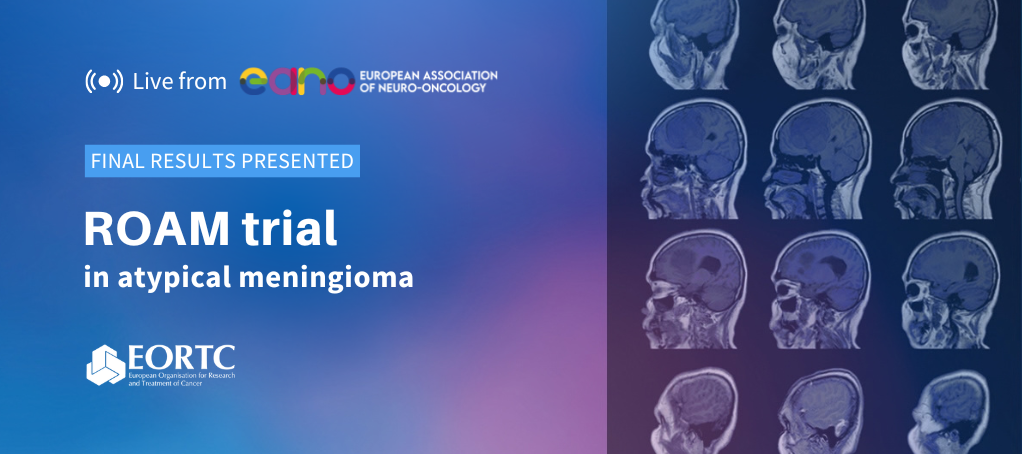
Giving radiotherapy after surgery for a type of brain tumour called atypical meningioma can halve the risk of the tumour returning, according to results from a major international clinical trial called ROAM (Radiation versus Observation following surgical resection of Atypical Meningioma).
Findings from the ROAM/EORTC-1308 trial, presented today at the 21st Annual Meeting of the European Association of Neuro-Oncology (EANO 2026), provide the strongest evidence to date that patients with completely resected atypical meningioma should be offered radiotherapy rather than observation alone.
Meningiomas are the commonest primary brain tumour and up to 2000 people undergo surgery each year in the UK. Atypical meningiomas account for around a quarter of meningioma and they are more likely to return than lower grade meningiomas. Until now, there has been uncertainty about whether patients should receive radiotherapy immediately after surgery or instead be monitored with regular brain scans and treated if the tumour comes back.
ROAM/EORTC-1308 is the first randomised controlled trial evaluating the role of radiotherapy compared to observation for reducing the risk of recurrence in patients who have undergone complete resection of atypical meningioma.
Between 2016 and 2021, 157 were randomly assigned to receive either radiotherapy or observation following complete surgical removal of their tumour. After a median five-year follow-up, 35 participants had their brain tumour recur – 14% in the radiotherapy group and 30% in the observation group. At five years, ~80% of patients who received radiotherapy remained free of recurrence, compared with ~60% of those who underwent observation. There were also no differences between the groups in terms of health-related quality of life and neurocognitive function, and there was minimal serious radiation-toxicity.
At the annual EANO meeting today (25/09/2026), the study was awarded 'EANO Best Oral Presentation for Clinical Research'.
Chief investigator and first author, Neurosurgeon Professor Michael Jenkinson, The Walton Centre NHS Foundation Trust in Liverpool, and RCS England / Sir John Fisher Foundation Chair of Surgical Trials the at the University of Liverpool, said:
“The trial tackles a question that has been debated for many years: whether patients with atypical meningioma should receive radiotherapy after surgery. I’m proud that our team has been able to generate robust evidence that can help patients and clinicians make better-informed decisions. Winning this award is a real honour and recognition of the many patients, investigators and collaborators who made the trial possible.”
“I work in neuro-oncology because brain tumours remain a major challenge for patients, families and clinicians, with many important questions still unanswered. I am motivated by the opportunity to work with patients and colleagues to turn those unanswered questions into research that can genuinely improve treatment and outcomes. For me, the most rewarding part is seeing research move from an idea into evidence that can change clinical practice and enable the next generation of neuro-oncology researchers.”
Professor of Radiation Oncology and radiotherapy co-lead for the trial, Professor Damien Weber at the Paul Scherrer Institute in PSI Villigen Switzerland said:
“For many years there has been genuine uncertainty about whether patients with atypical meningioma should have radiotherapy after surgery or be monitored. ROAM provides the first randomised evidence that early radiotherapy substantially reduces the risk of the tumour returning.”
“These results are important for patients and clinicians because recurrence can mean further surgery, further treatment and considerable anxiety. Our findings should now inform discussions about treatment following complete resection of an atypical meningioma.”
Commenting on the significance of the findings for the neuro-oncology community, Matthias Preusser, Chair of the EORTC Brain Tumour Group, said:
“The ROAM/EORTC-1308 trial shows that academic collaboration across countries and continents can generate meaningful progress for the field and our patients. We now know the answer to a question that has been around for decades and has been discussed frequently in tumor boards and patient consultations around the world. Radiotherapy has proven to be effective in delaying progression of completely resected atypical meningioma and should be offered to patients in this clinical scenario’’
ROAM/EORTC-1308 was carried out in 11 countries across the world and was a collaboration between the University of Liverpool, The Walton Centre NHS Foundation Trust in the UK, the European Organisation for Research and Treatment of Cancer (EORTC), and the Trans-Tasman Radiation Oncology Group (TROG).
The study was funded by the National Institute for Health and Care Research Health Technology Assessment Programme (NIHR-HTA), the EORTC Brain Tumour Group and Radiation Oncology Group and the National Health and Medical Research Council of Australia. Analysis was coordinated by the Liverpool Clinical Trials Centre (LCTC) at University of Liverpool
Read full article: https://doi.org/10.1016/S0140-6736(26)01804-0
About EORTC
The European Organisation for Research and Treatment of Cancer (EORTC) is a non-governmental, non-profit organisation, which unites clinical cancer research experts, throughout Europe, to define better treatments for cancer patients to prolong survival and improve quality of life. Spanning from translational to large, prospective, multi-centre, phase III clinical trials that evaluate new therapies and treatment strategies as well as patient quality of life, its activities are coordinated from EORTC Headquarters, a unique international clinical research infrastructure, based in Brussels, Belgium.
Contact information
EORTC Communications
Caroline Moulins, Head of Communications
T: +32 2 774 13 68
E: caroline.moulins@eortc.org
Related News
EORTC presents new results in neuro-oncology at EANO
28 Sep 2026
New results and forthcoming trials presented at ESMO 2025 underline EORTC’s commitment to patient-centred research
21 Oct 2025
Results from EORTC trial define new standard of care for aggressive brain tumours
18 Oct 2025
PET imaging widely used in European brain tumour centres, survey shows
1 Jul 2025
EORTC in the spotlight at ASCO 2025
4 Jun 2025
EORTC’s presence at ASCO 2025
28 May 2025
New study confirms link between cancer patients’ quality of life and survival
1 Apr 2025
New Treatment for Recurrent Meningioma: LUMEN-1 Clinical Trial
17 Mar 2025
New Insights into Glioblastoma Treatment for Older Adults Patients
8 Oct 2024
The EU funded project LEGATO officially started
4 Oct 2023