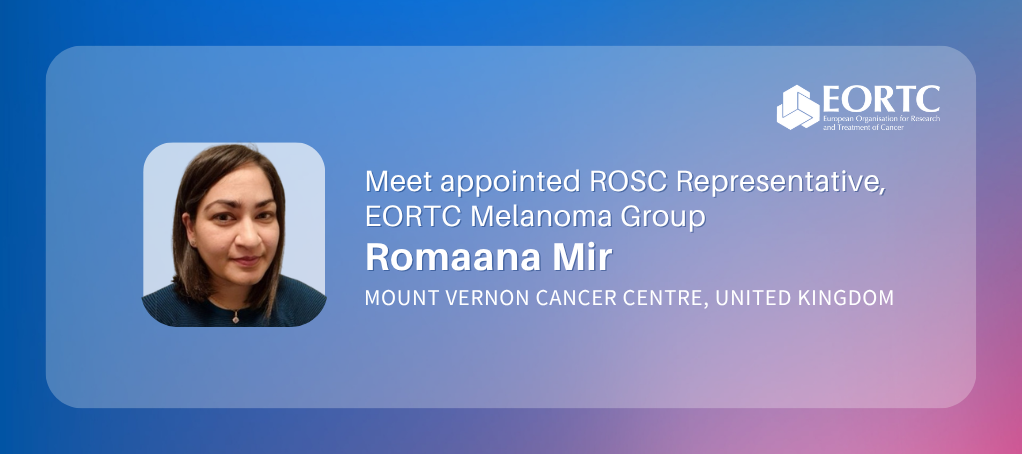
Meet appointed ROSC Representative, EORTC Melanoma Group, Romaana Mir
13 Oct 2026
As the new ROSC representative for the EORTC Melanoma Group, Dr. Romaana Mir brings expertise in both systemic therapies and radiation oncology for skin cancers. We spoke with her about current research challenges, collaboration across disciplines, and her priorities for the role.
Could you please introduce yourself and tell us about your current role, professional background, and the main areas of clinical and research interest?
Hi, I’m Romaana Mir, a Consultant Clinical Oncologist based at Mount Vernon Cancer Centre in the United Kingdom; I am dually a skin cancer systemic therapy prescriber and an expert in radiation therapy.
My clinical and research experience spans the management of immunotherapy-related secondary effects, clinical decision-making in melanoma, radiation and quality of life in the context of early skin cancer, and tumour-agnostic radiation reporting metrics alongside radiation quality assurance. I am radiation lead for the United Kingdom SCC-After Trial.
I work with ESTRO as the 2023–2029 Secretary for the Skin Cancer Focus Group, coordinating cross-disciplinary radiation research and development with partners in dermato-oncology, medical oncology, and industry.
The spectrum of skin cancers varies hugely, and treatment paradigms are increasingly multimodality. My clinical experience has given me a broad perspective on the role of radiation across different stages of cancer, and I strongly believe in collaborative research that addresses clinically relevant questions and translates research into better patient care.
For me, one of the great strengths of EORTC and ROSC is bringing together different disciplines and disease groups to answer questions that individual institutions cannot answer alone.
What motivated you to become involved in the EORTC and to take on the role of ROSC representative for the Melanoma Group?
The EORTC leads research that changes clinical practice across Europe and beyond.
I have worked alongside the EORTC Radiation Therapy Quality Assurance Group since 2018, and I currently contribute to the active PRIMALung Study, evaluating the benefit of prophylactic cranial irradiation in small cell lung cancer.
Becoming the EORTC ROSC Melanoma Group representative is therefore a natural progression for me. Radiation for skin cancer is commonly delivered through a patient-specific, tailored approach, however, the standards for radiation delivery and reporting in skin cancer are not yet defined. My clinical and research experience can help establish minimum baseline standards for the skin cancer community.
The EORTC ROSC structure is particularly attractive as it creates a bridge between disease-oriented groups and the wider radiation oncology community. As the Melanoma Group representative, my background in both systemic therapy and radiation therapy means I can help ensure that important melanoma and skin cancer research questions are considered from a radiation oncology perspective at the early stage.
Most importantly, I see this role as an opportunity to strengthen collaboration between disciplines and help develop clinical trials that are both scientifically ambitious and clinically relevant.
From your perspective, what are the most important research questions and opportunities currently facing radiation oncology in melanoma and skin cancer?
I think there are several important opportunities for radiation in melanoma and across skin cancers.
The role of radiation remains uncertain in the context of increasingly effective systemic therapies, particularly where there is a mixed radiological or pathological response. In clinical practice, radiation is used readily as a treatment for skin cancer, and incorporating radiation reporting metrics into EORTC clinical trials could improve interpretation of secondary outcome measures and help build the evidence base to guide oncologists in selecting the most appropriate treatment for individual patients.
We also need to better understand tumour heterogeneity. Not every patient with skin cancer follows the same disease trajectory. Integrating clinical factors, genomics and molecular characteristics, imaging and pathological outcomes may help us identify which patients are most likely to benefit from radiation therapy, systemic therapy, and which patients are unlikely to benefit.
Finally, the integration of radiation and systemic therapy represents a major research opportunity. There is an unmet need for prospective evidence on sequencing, timing, dose and fractionation, rather than relying predominantly on retrospective experience.
How do you think ROSC can best support the Melanoma Group in advancing on these questions and opportunities and improve outcomes for patients?
I think the ROSC can add value by bringing radiation expertise into skin cancer research early, rather than treating radiation as an intervention that is added after the main trial concept has been developed.
My clinical and research background crosses disciplines, and I would like to see close dialogue between ROSC and the Melanoma Group, particularly when considering trial methodology for mixed radiological or pathological response, oligometastatic and oligoprogressive disease, and intracranial metastases.
The ROSC can also contribute to trial methodology and establish radiation reporting metrics and radiation quality assurance. This means that when radiation is incorporated into a multinational study, we have confidence that skin cancer treatment is delivered consistently to a high standard and that the outcome data generated are reliable and interpretable.
Looking ahead, what would you like to achieve in your role as ROSC representative, and are there any specific priorities you hope to promote within the EORTC community?
My main aim is to help create opportunities for meaningful, collaborative research in melanoma and skin cancer, where radiation alongside systemic therapy can make a genuine difference to patients.
Early involvement of radiation oncologists when melanoma and skin cancer clinical trial concepts are being developed would promote cross-disciplinary working and enable the radiation question to be robustly designed from the outset.
I see this role with the ROSC as a continuation of the skills and experience which I have developed, and from the opportunities I have taken over the past 10 years. A priority for me is the development of the next generation of skin cancer researchers; the EORTC has a unique international network, and I think we should make the most of that network by creating opportunities for early-career investigators to contribute to meaningful cross-disciplinary projects.
Ultimately, I would like my contribution to be practical: identifying important unanswered questions, bringing the right people together, and helping turn good ideas into robust clinical research with verifiable readout that improves outcomes for patients in need.
Related News
Interview of ROSC Chair, Joost Vaerhoeff
28 Apr 2026
Unique series of workshops in partnership with the European Medicines Agency (EMA)
7 Feb 2024
RECIST disease assessment is effective for targeted treatment as well as classical chemotherapy
5 Apr 2019
EORTC trial to improve treatment for older patients with acute myeloid leukemia enrolls first patients
16 Dec 2014
EORTC’s Anastassia Negrouk speaks out on the EU Data Protection Regulation
15 Dec 2014
Male and female breast cancers are not identical
12 Dec 2014
New Data at ASH 2014 Highlight Progress of Pfizer’s Growing Portfolio in Blood Cancers
9 Dec 2014
EORTC to study cancer diagnostic/treatment approaches in nursing homes with the support of Armonea
3 Dec 2014
EORTC Medical Director Dr Vassilis Golfinopoulos talks about the aims of SPECTA
1 Dec 2014
Press releases from the 26th EORTC – NCI – AACR symposium on molecular targets in cancer therapeutics in Barcelona
24 Nov 2014
